Chapter One
The Sign
The sign said HEIRS HOME SERVICES in green letters on white plastic, and it had been hanging above our shop in the Dorado Court plaza since 1996, which made it the longest-surviving thing in the plaza besides the cockroaches and Mrs. Josephs, who ran the roti place next door and was, by general consensus, somewhere between seventy-nine and eternal.
My name is Howard Heirs. I fix things for a living. Furnaces, mostly. Also air conditioners, washing machines, dryers, hot water heaters, and the occasional dishwasher — the essential machines, the ones that keep a house from becoming a building. I do this in Scarborough, Ontario, which is the part of Toronto that Toronto pretends is somewhere else. If you've heard of Scarborough, it's because of Drake, or a stabbing, or because someone on Reddit called it "the Scarbs" and four hundred people showed up in the comments to either defend it with their lives or call it a wasteland, and both sides were correct, and the thread got locked within the hour.
I won't bore you with a full description of the place. Not yet. Here's the minimum viable Scarborough: it's where Toronto keeps the people who make Toronto work. The truckers and the nurses and the warehouse staff and the plumbers and the women who clean the offices on Bay Street and take the 54 Lawrence East home at night, past the strip malls and the plazas and the bungalows with the Christmas lights still up in March because nobody's had the time or the ladder. The city needs these people the way a body needs kidneys — urgently, constantly, without thinking about it, and with absolutely no plans to send a thank-you card.
Scarborough is flat. Not pancake-flat like the prairies — rolling-flat, the kind of flat where the sky is the tallest thing and the buildings know their place. The plazas sit low on the corners. Strip malls, mostly. L-shaped or U-shaped, with parking lots that are too big for the businesses they serve and too small for the condos they'll become.
The city did promise us a subway once. Then again. Then again. If you're counting, that's roughly once per election cycle since I was in diapers. Of course, the subway is technically a state issue now. Ontario became the 51st state in 2031. The merger, the annexation, the integration, the thing, nobody has settled on a word for it, which tells you everything. If it had been a good idea, we'd have named it by now. The flag has a new star. The money changed. The healthcare is still being "transitioned," which is the word governments use when they mean "dismantled but slowly enough that you can't point to the exact day it happened."
A state representative appeared at the plaza once to announce a "transit study." She had a photographer and a pair of jeans so new they still had the fold lines. She ate a doubles at Island Pot, posted the photo to Instagram, and called Scarborough "vibrant and resilient," which is what politicians call neighbourhoods they've decided to admire from a safe distance. She did not look at the seven empty storefronts. Nobody asked her to.
But I'm ahead of myself.
My parents were Clifford and Agnes Heirs. Between them they inherited almost nothing, which makes the surname aspirational fiction, like naming a sinking boat Prosperity.
Clifford came from Manchester, England, in 1991. Specifically: from a heating systems factory that closed and a marriage that didn't survive the factory closing, which was the standard Manchester sequence in the Thatcher aftermath. He landed in Toronto with a trade certificate in HVAC repair and a suitcase that was mostly wrenches. Agnes came from Sarajevo in 1993 for reasons that should be obvious and terrible. She arrived by way of a refugee camp in Germany and an uncle's pullout couch in Mississauga. They met at a Tim Hortons, because this is Canada and that is where the important things happen. He was fixing the heating unit. She was on the register. He told her the vent above the fryer was going to fail. She said she'd stopped hearing it months ago.
"That's the problem," he said.
He was talking about the vent. He was also, without knowing it, delivering a concise summary of the next forty years of Canadian economic policy.
They got married in 1995 at City Hall, because they couldn't afford a wedding and because Agnes said she'd rather spend the money on wrenches, which was the most romantic thing Clifford had ever heard and which he repeated for the rest of his life as evidence that he'd married the right woman. They opened the shop the next year. My father made the sign himself, drove to the sign place on Markham Road, asked for the cheapest combination, paid cash, and carried the thing back to the plaza on the roof of a van that had already seen better days. Green vinyl letters on white corrugated plastic. HEIRS HOME SERVICES. The typeface was whatever the sign shop had. The spacing was slightly off, the S in SERVICES was closer to the E than the other letters, which gave the sign a handmade quality that my father would have called an error and that I, thirty years later, found beautiful in the way that all imperfect things made by hand are beautiful when the hand is no longer here to make them.
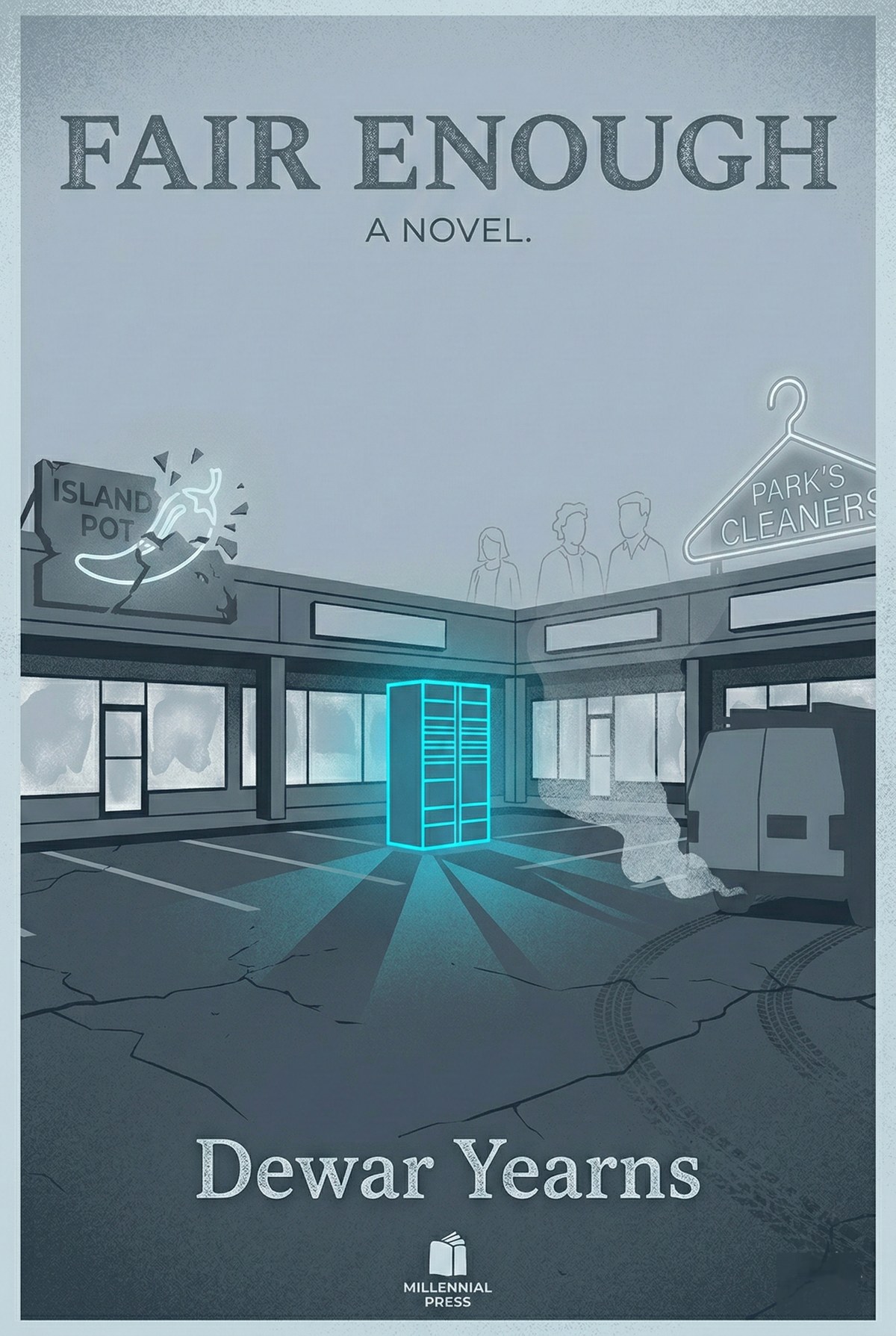
He hung it in the Dorado Court plaza between Island Pot (Jamaican roti, indestructible) and a tax preparer called Tax Palace (taxes, presumably, it's an Amazon locker now). The plaza was full then. Twelve units, twelve businesses, twelve signs. A dry cleaner. A travel agent. A video store. A dentist. A laundromat. A hardware shop that smelled like sawdust and possibility. The parking lot was busy. The bus stop at the corner had people in it. The neighbourhood had the specific hum of a place where things were working, not perfectly, not elegantly, but functionally, in the way that functional things hum: steady, unglamorous, reliable.
They fixed things. The neighbourhood needed things fixed. Everything was always a little broken, which was fine, because broken was the business model. A furnace fails, you fix it. A pipe leaks, you fix it. The loop was honest. People broke things. My parents fixed them. The money bought more wrenches. The wrenches fixed more things.
Here is a partial list of things that were true about Scarborough when my parents opened the shop:
- A bungalow cost $180,000. A family could buy one. A family did buy one. Clifford and Agnes bought one, semi-detached, on Brimorton, with a yard that Agnes kept and a garage that Clifford kept and a kitchen where they argued about the thermostat, which was the central drama of the Heirs household and which, in retrospect, was probably the founding myth of Heirs Home Services.
- The plazas were full. Not bustling, not booming, full. Every unit occupied. Every sign lit. The parking lot was a social space, not a logistics platform. You parked and you ran into people and the running-into was the point.
- You could raise a family on one trade income and have money left over to take the kids to Wasaga Beach in August. Your father would complain about the sand. Your mother would not complain about anything, because Agnes Heirs did not complain.
- The bus came every twelve minutes.
- The community centre pool was open seven days a week. It smelled like chlorine and childhood.
- Nobody had heard of the gig economy, because the regular economy still worked.
Here is what's true now:
- The bungalow costs $1.1 million. The bungalow has not improved. The bungalow has, if anything, gotten worse, the roof needs replacing, the furnace is the same one Clifford installed in 2003, and the driveway has a crack that has been growing since 2019 and that nobody has fixed because fixing it would cost $4,000 and the only people who can afford $4,000 driveways don't live in bungalows.
- Seven of twelve units in the plaza are empty, windows soaped white, the Scarborough funeral rite for dead businesses. The soap goes up when the lease ends. Nobody takes it down.
- You can raise a family on one trade income if "raise" means "keep alive" and you don't look at what "alive" requires.
- The bus comes when it comes. There is an app that tells you when, and the app is wrong, but at least you have something to stare at while you wait.
- The pool is closed for the season. The season is permanent. The sign hasn't been updated.
- The gig economy is just the economy. "We used to have benefits," your father says, and the sentence has the cadence of a fairy tale.
- You are technically an American, which you did not vote for, because the referendum was held during a period when everyone was too busy losing their jobs to notice they were also losing their country.
I was born in 1998, above the shop. Grew up in Scarborough. Dropped out of U of T Scarborough after two years, the satellite campus, the other one, the one downtown kids call "UTSC" the way you'd name a lesser moon, and came back to help my father, who had a stroke in 2019 and needed me more than the philosophy department did. He taught me the trade the way he'd learned it in Manchester: hands on the machine, ear to the metal, respect for the system you're working on because someone smarter than you designed it, even if the execution was shoddy.
Clifford died in 2024. Heart attack, not the stroke they'd been watching. That's maintenance for you, the catastrophic failure is never the one you're monitoring. You watch the thing you think will fail, the weakened vessel, the compromised function, the part that cracked in 2019 and has been under observation ever since, and the thing that actually kills you comes from the other direction, unmonitored, unannounced, on a Tuesday afternoon in March while you're watching the hockey game and arguing with the thermostat. He was sitting in the living room of the apartment above the shop. The thermostat was set to 22. He wanted it at 24. Agnes wanted it at 20. The compromise was 22, which satisfied nobody, which was the central metaphor of their marriage, which was otherwise excellent.
He was sixty-one. The funeral was at the church on Birchmount, Dennis's congregation, because Clifford didn't have a church but Dennis did, and Dennis's pastor agreed to do the service because Dennis asked, and the pastor said yes because that's what pastors do when Dennis Muamba asks, which is say yes, because Dennis asks for nothing and when he asks for something, it matters. The church was full. Not with family, Clifford's family was in Manchester and had stayed in Manchester, except for a brother who'd emigrated to Alberta and who sent a card and did not come. The church was full of customers. People whose furnaces Clifford had fixed. People whose kitchens he'd sat in. People who'd called a repair service and gotten a friend instead. They filled the pews. They wore their Sunday clothes on a Wednesday. They told stories about the man with the accent who fixed things with his hands and who always knew what was wrong before the diagnostic was done, because Clifford listened, Clifford always listened, and listening is the most undervalued skill in any trade and the one the System can never replicate.
Agnes died in 2027, in her sleep, in the apartment above the shop. She looked annoyed about it, which tracked. Agnes had been annoyed by most things, not bitterly, not unhappily, but with the specific Bosnian-Canadian irritation of a woman who had survived a war, a refugee camp, an immigration process, a marriage to an Englishman, and the Canadian healthcare system, and who regarded minor inconveniences as personal affronts. She had not been annoyed by death itself, she had been too practical for that. She'd been annoyed by the timing. She'd left a note on the counter: Howard, the furnace filter needs changing. The one in the shop, not the apartment. The note was written on a receipt from No Frills. The handwriting was firm. She'd written it the night before, probably, and died in the hours after, and the note was the last thing she wrote, and the last thing she said to me was about a furnace filter, which was either the most Agnes thing possible or the saddest, and I chose to believe it was the most Agnes thing, because the alternative was something I couldn't carry.
This left me, thirty, alone, running a business that was less a business and more an elaborate manifestation of grief that happened to occasionally fix someone's furnace.
Then I built the System.
I should capitalize that. The System. Capital S. You give the big things names so you can talk about them without screaming.
I'm not a programmer. I'm a furnace guy who turned out to be very good at describing problems to AI tools, which is, it turns out, the only skill the new economy actually values: the ability to tell a machine what you need in language it can act on. My father diagnosed furnaces by listening. I diagnosed business problems by talking to chatbots until they built me solutions. Different century. Same principle.
First I built a scheduling system. It was rough, a calendar with logic, basically, a thing that could look at the calls coming in and the technicians available and put them together without me staring at a whiteboard for twenty minutes every morning. Then a diagnostic module, feed it the model number, the symptoms, the customer history, and it would tell you what was probably wrong before the van left the lot. This was the thing that changed everything. This was the thing that took the art my father practised, the laying-on of hands, the listening, the diagnosis-by-intuition, and turned it into a probability matrix. Model X, symptom Y, 87% chance it's the ignition module. My father would have hated it. My father would also have been right 87% of the time, and the System learned its numbers from his numbers, so in a sense the System was Clifford, digitized, stripped of personality and tea-drinking and the ability to remember grandchildren's names, and running at a speed that no human hand could match.
Then a routing optimizer. Then automated invoicing. Then a customer communication layer so polished and empathetic that people started telling me they preferred it to a human, which was the goal, and also the thing that wakes me up at 3 AM in the apartment above the shop, where the System hums on the server below me like something dreaming about a world that doesn't need me in it.
Here's the thing they don't put on the brochure: when you make a business more efficient, you make it need fewer people. I started with seven technicians. The System found efficiencies. I went to five. More efficiencies. Four. By 2033, which is when this story happens, I was down to two: Dennis Muamba, who'd worked for my father since 2005 and could diagnose a furnace by laying his hand on it like a priest performing last rites, and Priya Chandrasekaran, twenty-three, engineer, the only person besides me who understood the System for what it was, a very elegant machine for making humans unnecessary.
The other five were gone. I'd had the conversations. Each one in the customer chair, because there was no office, just the counter, the chair, and a window onto a parking lot that was emptier every year. By the fifth one, I was efficient at it. I'd learned the pauses, the eye contact, the right amount of silence to leave after the news landed. I'd become good at firing people. Not a skill I'd wanted.
Here's the thing I told myself: at least I wasn't sending in the robots. You've seen them. Elon's things. The Optimus units, the ones that walk like a man who's been asked to act natural and has never met a natural person. They'd rolled them out in the warehouses along the 401, and in the long-term care homes where they were being "piloted" as "care assistants." Those goddamn robots. At least I was using software. At least my people were being replaced by an elegant system and not by a six-foot humanoid that walked like it was afraid of stairs. I told myself this a lot.
Three of them ended up on the Guaranteed Transition Benefit, the government's new program for people whose jobs have been automated away. Two found other work, one at a company in Mississauga that installed the same smart thermostats the System monitored, which was either ironic or inevitable, and one driving for a delivery service, which was the economy's answer to everything: take a person who used to fix things with their hands and put them in a car with an app. I'll explain the GTB later. It deserves its own chapter. It might be the funniest and saddest thing the Canadian government has ever produced, and the competition for that title is fierce.
Someone made a TikTok about the plaza. "POV: your neighbourhood gets optimized out of existence." Drone footage of the empty windows, the cracked lot, the one Amazon locker glowing blue in the dark like a nightlight for a dying mall. Half a million views. The comments were split between people who found it devastating and people who found it "aesthetic," which on that platform are the same category. Someone tagged the councillor. She didn't respond.
Fair enough.
• • •
